Seeking Alpha: News & Analysis
- 4.3
- Rating
- 1.00M
- Installs
- Free
- Price

 Analysis by App-foxy
I use Seeking Alpha mainly for one purpose: turning a stream of market information into something I can act on more thoughtfully. It is a finance app from SeekingAlpha that brings stock news, analysis, portfolio tracking, alerts, and real-time prices into one mobile workspace. That combination sounds broad, but its real value is more focused: it helps me connect a price move with the news and arguments surrounding it instead of looking at a chart in isolation.
That makes it different from a basic brokerage app. A brokerage is where I place orders and check account balances; this is where I investigate what may be happening before I decide whether a position deserves attention. I would not treat it as a substitute for investment advice or as a reason to trade more frequently. I see it as a research companion, especially useful when I want to follow several companies without opening a separate news app, charting tool, and watchlist.
Why the analysis layer matters more than another price screen
The app’s central capability is the relationship between market data and written analysis. A price alert can tell me that a holding moved, but it cannot explain whether the move relates to earnings, a company announcement, an industry development, or broader market sentiment. Seeking Alpha gives me a place to start that investigation, with financial news and analysis positioned beside the portfolio and price-monitoring functions.
You May Also Like

 Blood Strike: 2.5 Anniversary
Blood Strike’s Loadouts Turn Every Drop Into a Tactical Gamble
A close look at Blood Strike’s custom loadouts: how fast access to signature weapons reshapes its battle royale rhythm, rewards preparation, and narrows the gap between fights.

 Pandora - Music & Podcasts
Pandora’s Music Is Easy to Start, but Harder to Recover
Pandora’s strength is its low-effort path from a seed to a station. Its weak spot is how much confidence it asks you to place in connection, setup, and quiet recovery.

 8 Ball Pool
 Is Built on Rivalries, Rematches, and Routine
A close look at the rivalries, rematches, shared routines, and unanswered safety questions that turn a quick pool match into a persistent mobile community.

 Samsung Music
’s Quiet Strength Is Playing What You Already Own
Its reach comes less from spectacle than from dependable access to a personal library. That simplicity is both the app’s strongest retention engine and its ceiling.

 AccuWeather: Weather Radar
AccuWeather Review: A Quick, Clear Forecast for Everyday Decisions
For everyday plans, the best forecast is the one you can understand quickly. AccuWeather makes rain timing, radar, and local conditions easy to act on, with a few trade-offs.

 Hill Climb Racing
Why Hill Climb Racing Still Turns Crashes Into One More Run
A tiny car, a bumpy hill and one more upgrade: Hill Climb Racing keeps resurfacing because its simple chaos makes every near-miss feel personal.
More From Our News Desk



In everyday use, this changes the question I ask. Instead of simply wondering, “Why is this stock down?” I can move from the portfolio view toward relevant coverage and compare the current event with the opinions being presented. That does not make every article correct, and it certainly does not remove the need to check original company filings or other reliable sources. It does, however, reduce the friction between noticing a movement and beginning sensible research.
The important benefit is context, not prediction. The app is most useful when it helps me slow down an emotional reaction. A sudden rise can look exciting, while a sudden fall can feel alarming. Reading the surrounding analysis encourages me to ask whether the change affects my long-term reasoning or is simply short-term noise. For me, that is more valuable than a screen filled with extra indicators I may not understand.
Following a portfolio without checking every ticker manually
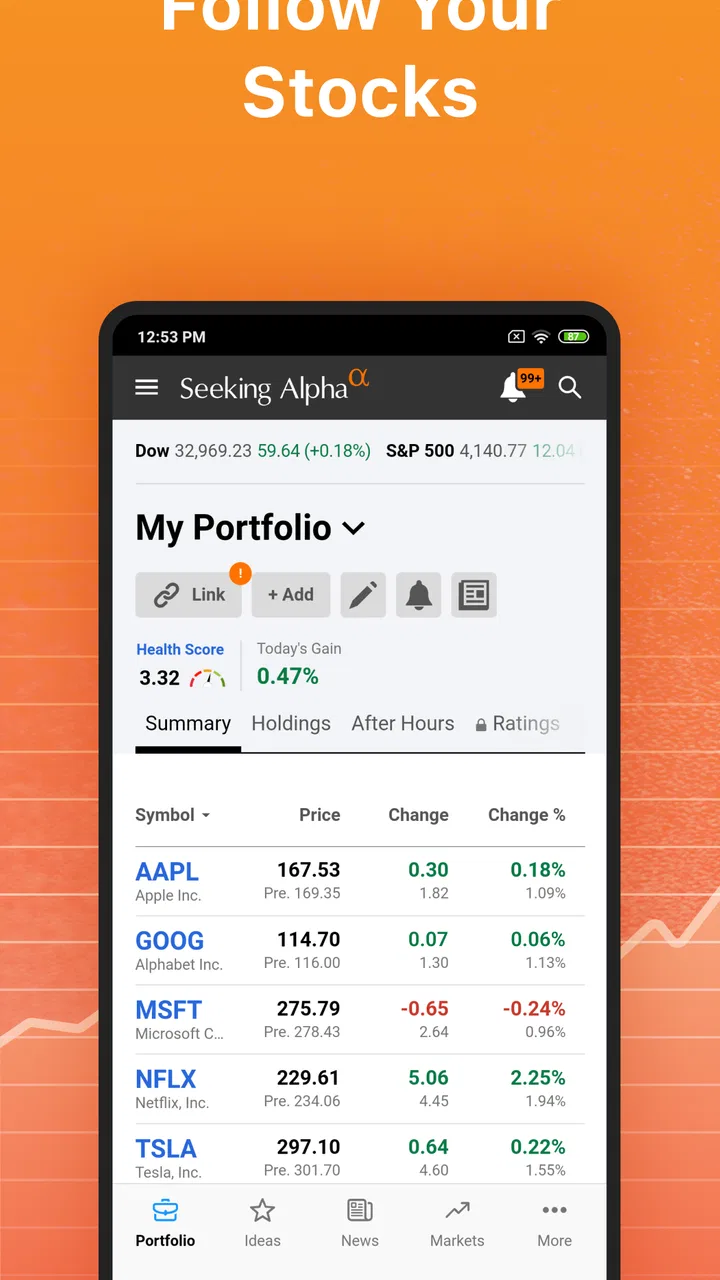
The portfolio area is practical for people who already have a group of companies they want to monitor. I can use it as a personal research list rather than treating it as a complete record of my investments. That distinction matters. A portfolio tracker is helpful for organizing attention, but it should not be confused with a broker’s official account information, order history, or tax records.
A realistic routine would be checking the app during a lunch break after noticing that one holding has moved more than expected. I would first look at the current price, then scan the related news and analysis, and finally decide whether the event deserves deeper reading later. If the movement is connected to a company update, I can add that topic to my research notes. If the coverage offers only speculation, I can avoid making an impulsive decision based on a headline alone.
This workflow is particularly useful for a long-term investor who wants fewer, better check-ins. I would not keep refreshing prices all day. Instead, I would let alerts draw my attention to meaningful changes and use the rest of the app to understand what happened. That approach can make the tool less distracting than a standalone market ticker, although anyone prone to compulsive checking should still be careful with notifications.
Using alerts as a filter instead of a source of urgency
Alerts are easy to misunderstand. Their best role is not to tell me what to buy or sell; it is to tell me when a familiar company deserves another look. I prefer setting alerts around companies I already understand, because a notification about an unfamiliar stock can create curiosity without giving me enough background to judge the situation.
A useful habit is to treat an alert as the beginning of a three-step review: identify the event, read more than one viewpoint, and compare it with the reason I originally followed the company. If the original investment idea remains intact, I may simply record the development. If the event changes the business case, I have a clearer reason to investigate further. This is a more disciplined use of alerts than reacting to every movement as a trade signal.
The trade-off is that alerts can make the market feel constantly active. For a person who wants a calm, low-maintenance investing experience, a brokerage app with limited notifications may be a better fit. Seeking Alpha is designed for people who want ongoing information, so it rewards users who configure their attention carefully rather than enabling every possible update.
Reading analysis without mistaking confidence for certainty
The written analysis is the feature I would approach with the most judgment. Different contributors can interpret the same company in very different ways, and a persuasive argument is not automatically a dependable forecast. I find the material most useful when I read it as a collection of theses to test, not as instructions to follow.
One practical method is to write down the claim behind an article in plain language. Is the argument about valuation, business growth, income, debt, competition, or a temporary event? Once I identify that claim, I can check whether the portfolio position actually depends on it. This prevents me from being distracted by an interesting article that has little connection to my own investment horizon.
I also pay attention to what would prove an argument wrong. If an analysis presents only reasons for optimism or only reasons for pessimism, I treat it as a starting point rather than a complete investigation. The app can make research more convenient, but convenience increases the temptation to stop after reading the first convincing opinion. Its strongest users will compare ideas and keep their own records of why they hold a company.
Where the app fits into real investing routines
When I think about how this app fits into an investing routine, I focus on the moments when a quick price check raises a bigger question: what changed, and does it matter to my plan? A useful next step is to decide which updates merit an immediate look and which can wait for a deliberate review. That distinction becomes especially important when I’m using the app away from a steady connection.
The strongest everyday scenario: monitoring a focused watchlist
Seeking Alpha works best for me when I follow a manageable set of companies and want a single place to notice developments. Imagine I own shares in several businesses across technology, consumer products, and energy. I do not need a constant stream about every listed company. I need timely awareness of the names that matter to my decisions, plus enough analysis to decide which news deserves serious attention.
In that situation, I would open the app at the start of the week to review the portfolio and scan important stories. During the week, an alert could bring me back when a price changes or a relevant development appears. Before making any decision, I would use the analysis as a prompt for further research, checking whether the event affects revenue prospects, costs, competition, or the original reason I invested.
The hidden advantage of this routine is prioritization. Instead of searching the entire market, I begin with companies already connected to my goals. That saves time and reduces the chance of chasing whatever stock is currently attracting the most attention. The app is not just a news reader in this workflow; it becomes a filter for deciding where my limited research time should go.
When a brokerage app is the better choice
If my main need is placing trades, viewing cash, managing orders, or keeping official investment records, I would use my broker first. Seeking Alpha is not the right center of gravity for those tasks. It can help me decide what deserves research, but the execution side belongs in the financial service that actually holds my account.
This separation is healthy. Mixing research and trading in one place can make it too easy to act immediately on an emotional response. Using this app for investigation and a broker for execution creates a small pause between the two. Some readers may find that pause useful; others may prefer the convenience of an all-in-one financial platform. The better option depends on whether research depth or transaction speed matters more to them.
When a simple market app is enough
Someone who only wants occasional prices may find the app more involved than necessary. If I check a few index levels once a week and do not follow individual companies closely, a simpler market tracker can be easier to understand. Seeking Alpha earns its place when I use the analysis, portfolio monitoring, or alerts rather than opening it only to glance at a number.
It is also not ideal for a reader who wants a single neutral summary. Analysis naturally involves interpretation, and interpretation requires judgment. I would skip this app if I knew I was likely to accept the most confident article as fact without comparing it with company information and other viewpoints. The abundance of commentary is an advantage for an engaged researcher, but it can be a weakness for someone looking for a completely passive experience.
What the free starting point means in practice
The app is free to start, which makes it easy to try the research workflow without committing money at installation. At the same time, the presence of in-app purchases means that some parts of the experience may be connected to paid access. The listed purchase range runs from less than a dollar to as much as two thousand four hundred dollars per item, so I would review any subscription or purchase screen carefully before confirming anything.
That pricing structure changes my recommendation slightly. I would begin by testing whether the free experience genuinely improves my routine. If I only use the price screen and occasional headlines, paying may not add enough value. If the analysis becomes central to how I evaluate companies, a paid option could be worth considering, but only after I know exactly which functions I would use regularly. I would never pay simply because an article makes a dramatic claim or because a market move creates urgency.
Privacy of attention is an overlooked trade-off
Financial apps compete not only for money but also for attention. News, alerts, changing prices, and opposing opinions can pull me into repeated checking. My practical solution would be to follow only companies relevant to my actual portfolio or research plan, then review alerts at chosen times instead of responding instantly.
This is one of the app’s less obvious trade-offs. The same stream that helps me notice important information can encourage short-term thinking. If my investment plan is measured in years, I need to prevent a daily price change from becoming more important than the business fundamentals. The app supports a thoughtful routine, but it cannot create that discipline for me.
How established is the app?
SeekingAlpha has been developing this finance product since August 21, 2012, and its scale suggests that it has become a familiar choice for market-focused users. It has passed one million installs, carries a 4.3 average from around forty-nine thousand ratings, and has around twelve thousand written reviews. Those figures tell me that the app has broad use, but they do not guarantee that every reader will like its balance between research, alerts, and paid content.
The Everyone age classification also makes it broadly accessible from an age-rating perspective. That should not be confused with suitability for every financial situation. Investing involves risk, and an app that makes information easier to reach can also make decisions feel easier than they really are. I would recommend learning the basics of valuation, diversification, and risk separately rather than expecting the app to teach all of them through its feed.
Small habits that make the research more reliable
I would use the app more effectively with a few simple rules. First, I would create a focused list instead of adding every interesting ticker. A crowded list turns alerts into background noise. Second, I would read the headline, identify the underlying claim, and then look for information that could challenge it. Third, I would record why a company matters to me before a major price move occurs, because it is much harder to think clearly after the market has already created fear or excitement.
Another useful habit is separating discovery from decision-making. I can discover a company through the news feed or an analysis article, but I would not treat discovery as due diligence. Before buying, I would move beyond the app’s commentary and examine the business, financial statements, valuation, and risks using appropriate primary sources. This keeps the app in its strongest role: helping me find questions worth answering.
I would also avoid comparing every company through a single lens. An income-focused argument may matter greatly for one holding and very little for a growth company. When I read analysis, I ask whether its assumptions match my goal, time horizon, and tolerance for loss. That simple check prevents me from borrowing someone else’s strategy without realizing it.
Who gains the most from this particular tool?
The best match is an investor who follows individual stocks, enjoys reading market commentary, and wants alerts tied to a personal watchlist. This person is likely to appreciate having prices, portfolio monitoring, news, and analysis close together. They do not need every answer delivered automatically; they want a faster way to decide what deserves deeper work.
It can also suit a newer investor who is willing to be skeptical and learn gradually. The app can expose that user to different ways of thinking about companies, but the learning benefit comes from comparing arguments rather than copying them. I would recommend it to a friend who already has a basic investing plan and wants a more organized research process.
I would be more cautious recommending it to someone seeking hands-off investing, guaranteed signals, or a replacement for professional financial advice. A person who dislikes financial news, feels stressed by price changes, or wants only simple account management may be happier with a broker, a passive investing service, or a lightweight market tracker. More information is not automatically better information if it leads to rushed decisions.
My final view after using it as a research companion
Seeking Alpha is most convincing when I use its analysis and alerts to add context to portfolio movements. The price data alone would not be enough to distinguish it from many finance apps, but the connection between a monitored company, current news, and competing interpretations gives the experience a clear purpose. It helps me organize research and notice developments without making me pretend that an app can predict the market.
I like it for focused watchlists, deliberate review sessions, and investors who want to understand why a stock is attracting attention. I would not use it as my broker, my only research source, or a button that tells me when to buy and sell. The free entry point makes experimentation straightforward, while the in-app purchase range means I would examine paid choices carefully and judge them by repeated use rather than excitement.
My recommendation is therefore positive but specific: choose it if you want a mobile research desk built around stock analysis and portfolio awareness. Configure it to support your plan, not to replace one. Used that way, it can turn a sudden market movement into a structured question instead of an impulsive reaction, which is the most useful result I get from it.
FAQs for Seeking Alpha: News & Analysis
01What features does Seeking Alpha: News & Analysis offer?
Seeking Alpha provides a comprehensive suite of tools and resources for investors, including real-time news updates, in-depth financial analysis, stock market insights, and personalized portfolio management. Users can access expert opinions, track favorite stocks, and participate in a community of investors to discuss market trends and strategies.
02Is Seeking Alpha free to use, or does it require a subscription?
Seeking Alpha offers both free and premium content. The free version provides access to a range of articles and news updates, while a subscription to Seeking Alpha Premium unlocks additional features such as exclusive analysis, advanced stock screeners, and ad-free browsing. Premium plans are available on a monthly or annual basis.
03How reliable is the information provided by Seeking Alpha contributors?
The platform hosts a diverse community of contributors, including financial analysts, industry experts, and seasoned investors. While Seeking Alpha aims to provide quality insights, it's essential for users to conduct their own due diligence and consider multiple opinions before making investment decisions. The platform also allows users to rate and comment on articles.
04Can I use Seeking Alpha on multiple devices?
Yes, Seeking Alpha is designed to be accessible across multiple devices. Users can download the app on both Android and iOS platforms and sync their accounts to access their portfolios, saved articles, and personalized settings on smartphones, tablets, and desktops. This ensures a seamless experience for users on the go.
05How does Seeking Alpha help with investment decisions?
Seeking Alpha aids investment decisions by offering a wealth of information and tools. Users can read expert analyses, access detailed financial data, and utilize stock screeners and charts. The app encourages informed decision-making by providing diverse perspectives and insights, which are crucial for successful investing.
Pros
- Comprehensive financial news coverage.
- Real-time stock market alerts.
- User-friendly interface.
- Access to expert analysis.
- Customizable watchlists.
Cons
- In-app ads can be intrusive.
- Subscription required for premium features.
- Limited offline content access.
- Occasional app crashes reported.
- Some features can be overwhelming.

Seeking Alpha: News & Analysis
Gallery